Teacher Quick Reference
⏱️- God sees what we cannot see.
- Trust shows itself through obedience.
- Following God may require courage when others don't understand.
- God is faithful to His promises.
"I can trust God and obey Him even when I don't know what happens next."
Teacher Preparation
Before class:
- Read Genesis 6–9.
- Read Genesis 6:9–22 especially carefully.
- Familiarize yourself with the main sequence of the story.
- Prepare the Trust the Next Step activity.
- Decide which age adaptation will work best for your group.
- Have the memory verse visible or written where students can see it.
[!IMPORTANT] A note for the teacher
The story of Noah contains serious themes, including God’s judgment and the destruction caused by the flood. Don’t avoid those themes, but present them with age-appropriate language. The purpose of this lesson is not to make the flood entertaining. The focus is: God is holy. God warned Noah. Noah trusted God. Noah obeyed. God was faithful to Noah and established His covenant.
Opening: Can You Trust the Next Step?
Ask the children: Have you ever had to do something when you didn’t know exactly what was going to happen?
Examples might include:
- Starting a new school
- Going somewhere for the first time
- Trying something difficult
- Following directions without knowing what was coming next
- Trusting a parent or teacher
Ask: Was it easier to trust when you already knew what was going to happen?
Then say: “Today we’re going to meet a man who had to trust God when he definitely did not know everything that was going to happen next.” Introduce Noah.
The Story of Noah
1. A World That Had Turned Away From God
Genesis tells us that the world in Noah’s time had become deeply corrupt and violent. God saw what was happening. But Genesis also tells us something important about Noah:
“Noah was a just man and perfect in his generations, and Noah walked with God.” — Genesis 6:9 (KJV)
Noah was living in a world that had turned away from God, but Noah was different. He walked with God. That doesn’t mean Noah was perfect in the sense of never making a mistake. It means that Noah’s life was oriented toward God. He trusted God and followed Him.
Ask: What do you think it means to “walk with God”? Help children understand: Walking with God means living in relationship with Him, listening to Him, trusting Him, and choosing His ways.
2. God Gave Noah An Extraordinary Assignment
God told Noah that a great flood was coming. Then God gave Noah detailed instructions for building an ark. The ark would be enormous. Noah was not given a small, easy assignment.
And there is something we should notice: Noah had never seen the flood before it came. He had to trust what God had told him.
Noah had a choice. He could have said:
- “That doesn’t make sense.”
- “What will everyone think?”
- “I’ll wait until I see some evidence.”
But Genesis tells us what Noah actually did:
“Thus did Noah; according to all that God commanded him, so did he.” — Genesis 6:22 (KJV)
That’s our memory verse. Noah trusted God—and his trust resulted in obedience.
3. Trust Is More Than Saying “I Believe”
It’s possible to say that we trust someone but never act on that trust.
Imagine a parent says: “There’s a puddle ahead. Walk this way.” A child says: “I believe you.” But then walks directly into the puddle. Did the child really act on what they believed?
Noah’s trust was visible. He built the ark. Day after day, he followed God’s instructions. Trust became obedience.
Main Point: When we trust God, our trust affects what we do. This doesn’t mean that obedience earns God’s love. It means that trusting God changes the way we respond to Him.
4. Noah Couldn’t See the Whole Plan
Imagine Noah standing beside the ark while it was being built. He could see wood, tools, animals, supplies, and an enormous boat. But he could not see the future.
He didn’t know exactly what the coming days would look like. He had to trust the God who could see what Noah could not.
That’s something we experience too. We don’t know everything that will happen tomorrow. We don’t know every reason God allows something to happen. We don’t know how every difficult situation will turn out. But we can know God.
Teaching Point: We may not know what comes next, but we can trust the God who does.
5. Following God Can Take Courage
Noah’s obedience probably looked strange to the people around him. Imagine explaining what you were building and why. Noah could have allowed embarrassment or fear of other people’s opinions to stop him. But Noah continued obeying God.
Ask: Have you ever been afraid that someone would laugh at you because you were doing the right thing?
Explain: Sometimes following God means making a choice that is different from what everyone around us is doing. That might mean telling the truth, refusing to join in when someone is being cruel, forgiving someone, standing up for someone who is being left out, or choosing what is right even when friends choose differently. Trusting God sometimes requires courage.
6. God Remembered Noah
The flood came. Noah, his family, and the animals entered the ark. The rain fell, and the waters rose. Eventually, the waters began to go down. Genesis 8:1 says:
“And God remembered Noah…” — Genesis 8:1 (KJV)
When the Bible says God “remembered” Noah, it does not mean God had forgotten that Noah existed. It means God turned His attention toward Noah and acted on his behalf. God was still faithful. Noah had trusted God through a long and difficult period. God had not abandoned him.
7. God Made a Covenant
After the flood, God established a covenant with Noah. God placed the rainbow in the cloud as a sign of His covenant. The rainbow became a reminder of God’s promise.
The story doesn’t end simply with: “Noah built a boat.” It ends with: God is faithful.
That matters because our confidence isn’t ultimately in how strong our own faith feels. Our confidence is in the God we trust.
Three Things to Remember
- God Sees What I Cannot See: Noah couldn’t see the coming flood. God could. We can’t see everything that will happen in our lives. God sees what we cannot. When I don’t understand, I can still trust God.
- Trust Shows Up in What I Do: Noah didn’t simply say he believed God. He obeyed. Our trust in God should affect our choices. Trust isn’t only something we say. It’s something we live.
- God Is Faithful: God did not abandon Noah. God kept His promises. The rainbow reminds us of God’s covenant. God is worthy of our trust because He is faithful.
Age Adaptations
Younger Children
For younger children, keep the lesson centered around three simple ideas:
- God knows what is best.
- Noah didn’t understand everything, but he listened to God and obeyed.
- God took care of Noah and was with him through the flood.
Simple Question: “If you can’t see what happens next, can you still trust God?” Simple Take-Home Truth: “I can trust God even when I don’t know what happens next.”
Older Children
Older children can explore the difference between: belief → trust → obedience.
Discuss situations where God’s instructions may conflict with peer pressure. Ask:
- What makes obedience difficult?
- Is it easier to obey when we understand the reason?
- What should we do when we don’t understand what God is doing?
- Can trusting God mean doing something difficult?
- How can we know whether we’re following God or simply doing what we want?
Discussion Questions
Understanding
- Why did God tell Noah to build the ark?
- What did Noah do after God gave him instructions?
- What happened after the flood?
- What did God place in the cloud as a sign of His covenant?
Thinking
- Why do you think it might have been difficult for Noah to obey God?
- How do you think Noah felt when he didn’t know exactly what would happen?
- What’s the difference between saying “I trust God” and actually trusting God?
- Why might it take courage to follow God when other people don’t understand?
Personal Application
- Is there something in your life right now that you don’t understand?
- How could you show trust in God through your actions this week?
- What can you remember when you’re worried about what happens next?
Activity Time
Craft Time
Purpose
To help children remember that the rainbow is not just a pretty picture in the sky, but a specific sign of God’s promise to Noah and to all of humanity.
Setup
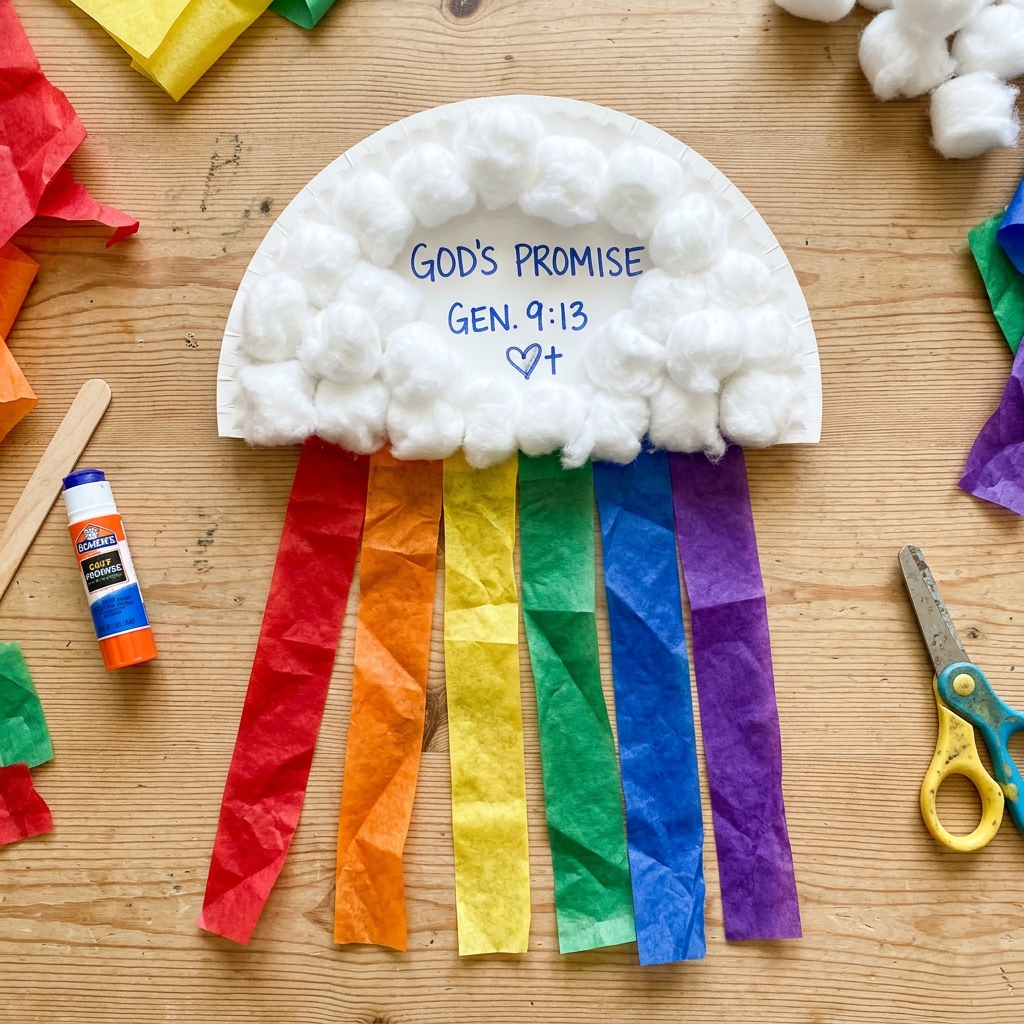
- Cut the paper plates in half so each child gets a semi-circle shape.
- Pre-cut the tissue paper into long strips (about 1 inch wide and 8 inches long).
- Place a pile of cotton balls and tissue paper strips at each table.
Instructions
- The Clouds: Give each child a half-plate. Have them spread glue all over the bumpy side of the plate and press cotton balls into the glue so the plate looks like a fluffy white cloud.
- The Rainbow: Have the children flip their “cloud” over. Along the straight bottom edge, have them glue the tops of the colored tissue paper strips in rainbow order (Red, Orange, Yellow, Green, Blue, Purple).
- When they hold the cloud up, the colorful rainbow strips will dangle down beautifully!
- The Promise: Have older children write (or help younger children write) “God Keeps His Promises” on a piece of paper and glue it to the center of the cloud, or just write it directly on one of the tissue paper strips.
Discussion While Crafting
- “How long was Noah inside the dark, smelly ark while the rain poured outside?” (A long time!).
- “When Noah finally got out, what was the first thing God put in the sky?” (A rainbow).
- “What did the rainbow mean?” (God promised He would never flood the whole earth again).
- “Whenever you look at this craft hanging in your room, remember that God always keeps His promises, even when things are scary!”
Memory Verse
Genesis 6:22 (KJV)
“Thus did Noah; according to all that God commanded him, so did he.”
Teach It in Three Parts:
- Thus did Noah ↓
- According to all that God commanded him ↓
- So did he
Explain: The verse describes action. Noah heard God’s command. Noah trusted God. Noah did what God commanded.
Memory Verse Challenge: Have children say the verse together. Then remove one phrase. Have them repeat it. Remove another phrase. Continue until they can say the verse from memory. For younger children, let them repeat the verse with hand motions.
Knowledge Check
Knowledge Check
Question 1 of 5Loading...
Application and Closing
Application: Ask: What is one thing you are worried about because you don’t know what happens next?
Take-Home Challenge: Ask students to identify one area where they need to trust God this week. It might be: a friendship, school, family, fear, a decision, or something they cannot control. Encourage them to pray or write: “God, I don’t know what happens next, but I choose to trust You.”
Closing Prayer: “Lord, thank You that You see what we cannot see. Sometimes we feel worried or afraid because we don’t know what will happen next. Help us to be like Noah—to trust You and obey You even when it is difficult or when other people don’t understand. Thank You for always being faithful and keeping Your promises. In Jesus’ name, Amen.”