Teacher Quick Reference
⏱️- A lawyer asked Jesus, 'Who is my neighbor?' to try and trick Him.
- Jesus told a story about a man who was beaten by robbers and left for dead.
- A priest and a Levite both walked right past the injured man without helping.
- A Samaritan—an enemy of the Jewish people—stopped to bandage and care for the man.
- Jesus said true neighbors are those who show mercy to anyone in need.
"I can show God's love by helping anyone who is in need."
Teacher Preparation
Before class:
- Read Luke 10:25-37 (BSB). Pay attention to the lawyer’s motivation: he wanted to “justify himself” (verse 29). He wanted Jesus to give him a narrow definition of “neighbor” so he could feel good about the people he was already loving, and the people he was ignoring.
- Gather the toilet paper rolls for the First-Aid Relay.
- Write the memory verse on the board.
- Decide which age adaptation will work best for your classroom.
Opening Activity: The Boundary Line
Use tape to make a large square on the floor. Tell the children: “Everyone step inside the square! If you are inside the square, you are my neighbor, and I have to be nice to you.” Then point to a child and say: “Okay, you step outside the square. Since you are outside, I don’t have to share my toys with you. I don’t have to be nice to you.” Move a few more children outside the square. Ask them how it feels to be told they aren’t “neighbors.”
Explain: “This sounds mean, right? But this is exactly what the religious leaders in Jesus’ day did! They drew invisible lines. They decided they only had to love the people inside their circle. Today, Jesus is going to tell a story that completely wrecks that circle!”
The Bible Story
1. The Trick Question
One day, an expert in the religious law stood up to test Jesus. He asked, “Teacher, what must I do to inherit eternal life?”
Jesus asked him what the Law said. The lawyer answered perfectly: “Love the Lord your God with all your heart… and love your neighbor as yourself.” (Luke 10:27, BSB).
Jesus told him he was right. But the lawyer wasn’t satisfied. He wanted to find a loophole. He wanted to “justify himself” (prove that he was already good enough). So he asked a tricky question:
“And who is my neighbor?” (Luke 10:29, BSB)
He was basically asking, “Jesus, exactly who do I have to love? And who am I allowed to ignore?”
2. The Robbers
Instead of arguing, Jesus told a story (a parable). A Jewish man was traveling down the steep, rocky road from Jerusalem to Jericho. It was a dangerous road, famous for bandits. Suddenly, a group of robbers attacked him! They stripped him of his clothes, beat him up terribly, and ran away, leaving him half dead in the dirt.
3. The Religious Leaders
A little while later, a Jewish Priest came walking down the same road. Priests were the most important religious leaders. Surely he would help! But when the priest saw the bleeding man, he crossed over to the other side of the road and kept walking. He didn’t want to get his hands dirty.
Next, a Levite came down the road. Levites were the men who helped run the Temple. But when the Levite saw the man, he also crossed to the other side and ignored him. The people who knew the Bible the best were the ones who refused to help.
4. The Shocking Hero
Then, Jesus introduced the third person to walk down the road: a Samaritan. When Jesus said the word “Samaritan,” the Jewish crowd listening to the story probably gasped. Jews and Samaritans hated each other. They were enemies who wouldn’t even speak to each other. The crowd probably expected the Samaritan to kick the injured Jewish man!
But Jesus shocked everyone.
“But a Samaritan, as he traveled, came where the man was; and when he saw him, he took pity on him.” (Luke 10:33, BSB)
5. Going Above and Beyond
The Samaritan didn’t just feel bad for the man; he took action. He got off his donkey, walked over, poured soothing oil and wine on the man’s wounds, and bandaged him up.
Then, the Samaritan put the injured enemy on his own donkey, walked him to an inn (a hotel), and stayed up all night taking care of him. The next morning, the Samaritan gave the innkeeper two silver coins (two days’ wages) and said, “Look after him, and when I return, I will reimburse you for any extra expense you may have.”
Jesus turned to the lawyer and asked: “Which of these three do you think was a neighbor to the man who fell into the hands of robbers?” The lawyer couldn’t even bring himself to say the word “Samaritan.” He just muttered, “The one who had mercy on him.” Jesus told him: “Go and do likewise.”
The Deeper Meaning
The lawyer wanted to know “Who is my neighbor?” so he could draw a circle around the people he was required to love. But Jesus flipped the question. Jesus essentially asked, “What kind of neighbor are YOU being?”
The priest and the Levite had all the right answers in their heads, but no love in their hearts. The Samaritan showed us what God’s love looks like. It is messy. It costs time and money. And it crosses boundary lines. As Christians, we are called to love like the Samaritan, because while we were still sinners and enemies of God, Jesus came down, rescued us, and healed our wounds. Jesus is our ultimate Good Samaritan!
Three Things to Remember
1. Love is an Action
The priest and Levite might have felt sorry for the man, but they didn’t do anything. Love isn’t just a feeling; love is doing something to help. Teacher Question: What is an action you can do today to show love to someone in your family?
2. Everyone is Your Neighbor
Your neighbor isn’t just the person who lives next door, or the person who looks like you, or the person who goes to your church. Your neighbor is anyone who is in need. Teacher Question: Is it hard to be kind to someone who looks or acts differently than you do?
3. We Must Love Our Enemies
The Jews and Samaritans were enemies. Jesus teaches us that true love means helping people even when they don’t like us. Teacher Question: How did Jesus show love to His enemies when He was on the cross? (He prayed, “Father, forgive them”).
Age Adaptations
Younger Children
For younger children (ages 5–7), focus on the contrast between walking away and stopping to help.
Simplified concepts:
- A man was hurt very badly by robbers and left on the side of the road.
- Two important, religious men walked right past him and didn’t help.
- A Samaritan man walked by. Samaritans and Jews usually didn’t like each other.
- But the Samaritan felt bad! He stopped, put bandages on the hurt man, and paid for him to stay in a hotel to get better.
- Jesus says we should be like the Good Samaritan and help people when they are hurt or sad.
Developmentally appropriate questions:
- Did the first two men stop to help? (No).
- What did the Good Samaritan use to help the hurt man? (Bandages, his donkey, his money).
- Should we only help our best friends, or should we help everyone? (Everyone!).
Older Children
For older children (ages 8–11), focus on the lawyer’s motivation (justifying himself) and the radical nature of loving an enemy.
Deeper discussion: Pre-teens are very aware of social cliques and groups. They know exactly who the “Samaritans” (outcasts/enemies) are in their school environment.
Discussion Scenarios:
- Scenario 1: Someone drops all their books in the hallway. They happen to be the kid who made fun of your shoes yesterday. What would the Priest do? What would the Samaritan do? What would you do?
- Concept: Why did the lawyer ask the question in the first place? (To justify himself). We do this all the time! We say, “Well, I don’t have to be nice to her because she started it.” Or, “I don’t have to share with him because he’s not my real friend.” Jesus destroys our excuses. Love has no loopholes.
Discussion Questions
Understanding
- Why did the religious lawyer ask Jesus a question? (To test Him and justify himself).
- What happened to the Jewish man traveling to Jericho?
- What did the priest and the Levite do when they saw the hurt man?
- How did the Samaritan take care of the man’s wounds?
- What did the Samaritan tell the innkeeper the next morning?
Thinking
- Why was it so shocking to the crowd that Jesus made the Samaritan the hero of the story?
- Why do you think the priest and the Levite didn’t stop? (Maybe they were in a hurry, afraid the robbers were still there, or just didn’t care).
- How did Jesus answer the lawyer’s question, “Who is my neighbor?”
Personal Application
- Is there a “group” of kids at school that you usually ignore or avoid? How can you be a neighbor to them?
- Has anyone ever been a “Good Samaritan” to you when you were hurt or in trouble?
- How can you remember to put your love into action this week, instead of just feeling bad for people?
Activity Time
Craft Time
Purpose
To give children a physical representation of the Good Samaritan’s kindness by letting them “bandage” a hurt person and brainstorm ways they can help others.
Setup
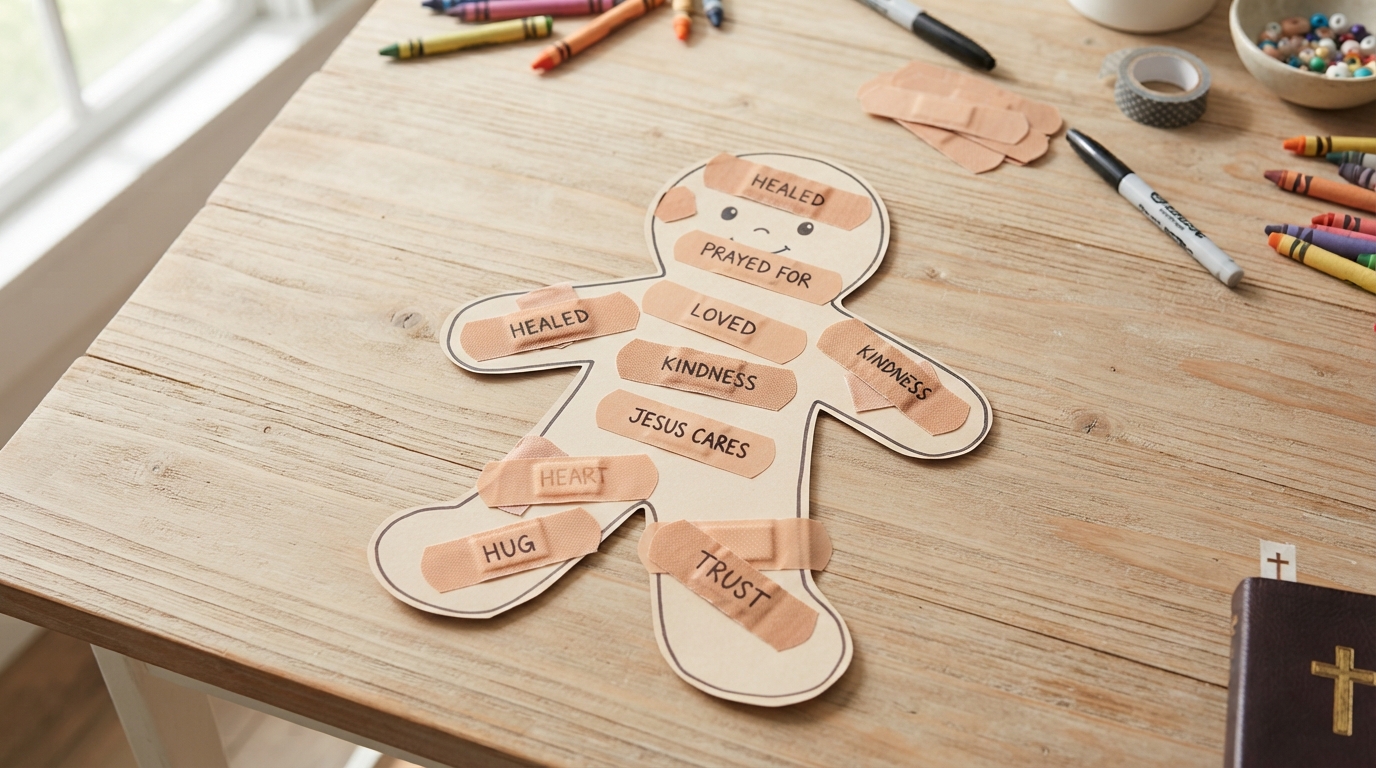
- Print or draw a large, simple outline of a person (like a gingerbread man shape) on white paper for each child.
- Put a pile of real band-aids (or small strips of toilet paper and glue sticks) at each table.
Instructions
- Decorate the Person: Have the children color the person on their paper.
- The Bandages: Give them the band-aids. Have them stick the band-aids all over the paper person, pretending they are the Good Samaritan taking care of the hurt man’s wounds. (If using toilet paper strips, have them glue the strips on like mummy wraps!).
- How to Help: For older children, have them write one way they can help someone in need on top of each band-aid (e.g., share a toy, sit with the lonely kid at lunch, help mom clean).
Discussion While Crafting
- “Did the priest or the Levite put bandages on the hurt man?” (No, they walked by on the other side of the road).
- “Who stopped to help the man?” (The Samaritan).
- “Jesus said we should love our neighbor. Who is our neighbor?” (Everyone! Even people who are different from us).
- “How can you be a Good Samaritan this week?”
Memory Verse
Luke 10:27 (BSB)
”…’Love the Lord your God with all your heart… and love your neighbor as yourself.’”
Practical Way to Teach:
- “Love the Lord your God” (Point up to heaven).
- “with all your heart…” (Put both hands over your heart).
- “and love your neighbor” (Point to the person standing next to you).
- “as yourself.” (Give yourself a big hug).
Knowledge Check
Knowledge Check
Question 1 of 5Loading...
Application
It is easy to love your best friend. It is really hard to love someone who is annoying, mean, or different from you. But Jesus commands us to love our neighbors, and that includes everyone! This week, if you see someone sitting alone at lunch, or struggling to carry something, be a Good Samaritan. Don’t walk past them; stop and help!
Take-Home Challenge
Take a few band-aids and put them in your pocket or backpack. Every time you feel the band-aids this week, ask yourself, “Is there anyone around me whose feelings are hurt? How can I show them God’s love today?”
Closing Thought
The lawyer wanted to know the absolute minimum he had to do to get to heaven. But Jesus showed him that God’s love doesn’t do the “minimum.” God’s love goes above and beyond. We were like the injured traveler—broken by sin and unable to save ourselves. But Jesus, our ultimate Good Samaritan, came down, bound up our wounds, and paid the ultimate price to rescue us. Because He loves us that much, we should love others the same way.
Closing Prayer
“Heavenly Father, thank You for loving us so much. Thank You that Jesus came to rescue us when we were broken by sin. Forgive us for the times when we walk right past people who are hurting. Give us eyes to see people the way You see them. Help us to be Good Samaritans this week, showing Your love and mercy to everyone we meet. In Jesus’ name, Amen.”
One-Minute Teacher Quick Reference
THE GOOD SAMARITAN
Luke 10:25-37
Big Idea
True love means helping people who need it, even if they are different from us or considered our enemies.
Memory Verse
”…’Love the Lord your God with all your heart… and love your neighbor as yourself.’” — Luke 10:27 (BSB)
Three Points
- Love is an Action
- Everyone is Your Neighbor
- We Must Love Our Enemies
Opening
The Boundary Line (Discussion using a taped square to show how we wrongly exclude people).
Activity
First-Aid Relay (Active team game wrapping teammates in toilet paper bandages).
Take-Home Truth
I can show God’s love by helping anyone who is in need.
Closing
Pray for a heart of compassion that is willing to cross boundary lines to show God’s love.