Teacher Quick Reference
⏱️- God sent a drought to Israel because of the evil King Ahab.
- God miraculously fed Elijah using ravens by a brook.
- When the brook dried up, God sent Elijah to a poor widow in Zarephath.
- The widow only had enough flour and oil for one last meal.
- She trusted God, and her flour and oil never ran out until the famine ended.
"I don't have to be afraid, because God will always provide what I need."
Teacher Preparation
Before class:
- Read 1 Kings 17 (BSB). Notice how the chapter is structured around three instances of God providing for Elijah (the ravens, the endless flour, and the raising of the widow’s son).
- Note: For this lesson, we are focusing on the flour and oil. You can briefly mention the healing of her son at the end as ultimate proof of God’s power.
- Prepare the pitcher and cup for The Empty Jar activity.
- Write the memory verse on the board.
- Decide which age adaptation will work best for your classroom.
Opening Activity: The Last Bite
Ask the children: “Imagine you have your absolute favorite candy bar in your hand. It’s the very last one in the world. You are about to take a bite, and your brother or sister walks in and says, ‘Can I have that?’ What would you do?”
Allow the children to laugh and share their honest answers.
Explain: “It is really hard to share when we know we only have a little bit left. Today we are going to learn about a woman who was asked to share her very last bite of food. But because she trusted God, she got to see an amazing miracle.”
The Bible Story
1. The Drought and the Ravens
Israel was being ruled by a very evil king named Ahab. Ahab worshiped false gods and led the people away from the one true God. So, God sent a prophet named Elijah to give Ahab a message: “As the LORD, the God of Israel, lives… there will be no dew or rain during these years except by my word!” (1 Kings 17:1).
No rain meant no crops. No crops meant no food. It was a terrible drought. But God had a plan to take care of Elijah. He told Elijah to hide by a brook. He had fresh water to drink, and God commanded ravens (large black birds) to bring Elijah bread and meat every morning and every evening! God can use anything—even birds—to provide for His people.
2. The Brook Dries Up
Eventually, because there was no rain, the brook dried up. Elijah had no water. Did God panic? No. God gave Elijah new instructions:
“Get up and go to Zarephath of Sidon, and stay there. Behold, I have commanded a widow there to provide for you.” (1 Kings 17:9, BSB)
A widow is a woman whose husband has died. In those days, widows were usually very, very poor.
3. The Last Meal
Elijah walked to the town gates of Zarephath and saw a woman gathering sticks. He asked her for a cup of water, and as she was going to get it, he asked for a piece of bread, too.
The woman turned to him and told him the sad truth:
“As surely as the LORD your God lives… I have no bread—only a handful of flour in a jar and a little oil in a jug. Look, I am gathering a couple of sticks to take home and prepare a meal for myself and my son, so that we may eat it and die.” (1 Kings 17:12, BSB)
She was starving. She was going to make one final, tiny loaf of bread for her and her boy, and then they were going to starve to death.
4. An Amazing Promise
Elijah said to her, “Do not be afraid.” He told her to go ahead and make the bread, but to make a small loaf for him first, and then make some for her and her son. That sounds incredibly selfish, doesn’t it? Why would Elijah ask for her last bite of food?
Because Elijah wasn’t just asking for her food; he was giving her a promise from God! Listen to what God promised:
“For this is what the LORD, the God of Israel, says: ‘The jar of flour will not be exhausted and the jug of oil will not run dry until the day the LORD sends rain on the face of the earth.’” (1 Kings 17:14, BSB)
5. The Miracle
The widow had a choice. She could look at her empty jar and say, “No way! This is mine!” Or, she could trust God’s promise.
She chose to trust God. She went home, mixed her handful of flour with her drops of oil, and baked the bread for Elijah.
And then, a miracle happened. She looked in the jar… and there was more flour! She looked in the jug… and there was more oil! The Bible says she, her son, and Elijah ate for many days. The jar of flour never ran out, and the jug of oil never ran dry, just as the Lord had promised. God provided exactly what they needed, every single day, until the rain finally came back.
The Deeper Meaning
Why didn’t God just give the widow a giant warehouse full of grain? If God can do miracles, why did He only give her a handful of flour at a time?
Because God wanted her to learn to trust Him every single day. If she had a warehouse of food, she would trust the warehouse. By only having a handful of flour in the jar, she had to wake up every morning and say, “God, I trust You to provide for me today.”
Hundreds of years later, Jesus taught His disciples to pray the exact same way. In the Lord’s Prayer, Jesus said, “Give us this day our daily bread” (Matthew 6:11). God wants us to depend on Him daily. He is our Provider, and His supply never runs out.
Three Things to Remember
1. God is our Provider
Whether He uses ravens by a brook or a miracle in a jar, God knows exactly what we need. Everything we have is a gift from Him. Teacher Question: What is something God has provided for you today?
2. We Don’t Have to Be Afraid
Elijah told the widow, “Do not be afraid.” Fear makes us want to hold onto our stuff and not share. Trusting God makes us generous. Teacher Question: Why is it easier to share when you know God will always take care of you?
3. God Multiplies What We Give Him
The widow gave God the tiny bit of flour she had, and God multiplied it. When we give God our small talents, our time, or our resources, He can do miracles with them. Teacher Question: What is something “small” you can give to God?
Age Adaptations
Younger Children
For younger children (ages 5–7), focus on the fun miracle of the endless flour and the birds bringing food.
Simplified concepts:
- There was no rain, so there was no food.
- God sent birds to bring Elijah meat and bread!
- Elijah met a lady who only had enough flour to make one more tiny loaf of bread.
- She shared it with Elijah because God promised He would take care of her.
- Every time she looked in her jar, there was more flour! It never ran out!
Developmentally appropriate questions:
- What kind of bird brought Elijah food? (Ravens).
- When the lady made bread, did her flour jar get empty? (No, God kept filling it!).
- Does God take care of us when we need things? (Yes).
Older Children
For older children (ages 8–11), focus on the concept of trusting God with our resources, and the tension of Elijah asking for her food first.
Deeper discussion: It sounds really bold for a prophet to walk up to a starving woman and say, “Make me a sandwich first.” Help the older kids understand that this was a test of faith, not Elijah being greedy.
Discussion Scenarios:
- Scenario 1: Why did God send Elijah to a starving widow in a foreign country instead of a rich king in Israel? (God often works through the weak and humble to show His power, and Israel’s king had rejected God).
- Concept: Tithing (giving a portion of our money to God’s work) is a lot like this story. God asks us to give to Him first, trusting that He will bless the rest of what we have. It requires faith to give when you feel like you don’t have enough.
Discussion Questions
Understanding
- How did God feed Elijah when he was hiding by the brook?
- Why did the brook dry up?
- How much food did the widow have left when Elijah met her?
- What did Elijah ask the widow to do before she made food for herself and her son?
- What was God’s promise to the widow about the jar of flour?
Thinking
- Why do you think it was hard for the widow to obey Elijah?
- How is trusting God for “daily bread” different from trusting a giant warehouse of food?
- What does this story teach us about God’s power over nature?
Personal Application
- What is something you are afraid of running out of? (Money, friends, time?)
- Has God ever provided for you in a surprising way?
- How can you practice giving God the “first” and “best” part of your life this week?
Activity Time
Craft Time
Purpose
To create a physical reminder of God’s provision, tying into the widow’s jars of flour and oil that never ran empty.
Setup
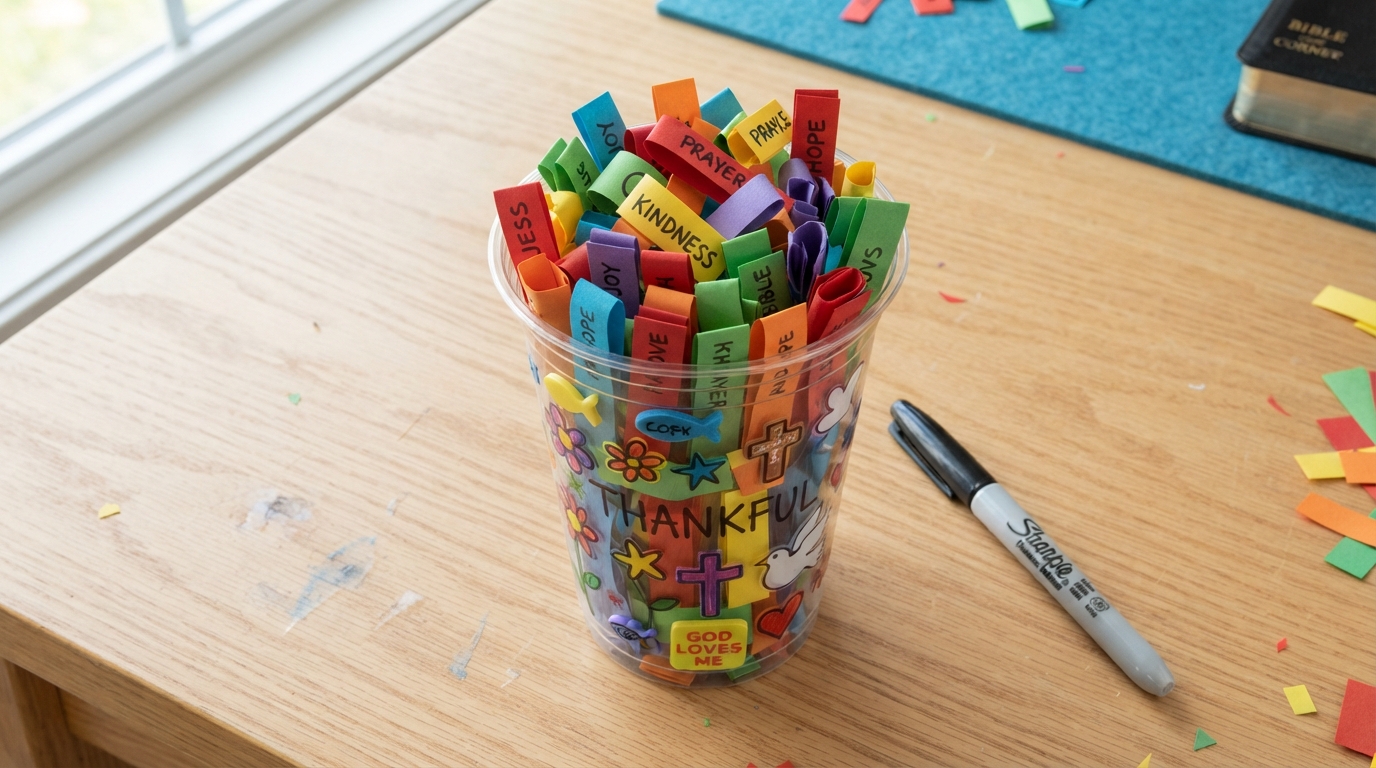
- Pre-cut colorful paper strips of paper (about 1 inch wide and 4 inches long) so there are plenty for each child.
- Have the decorating supplies laid out at the tables.
Instructions
- Decorate the Jar: Give each child a clear plastic cup or small jar. Let them decorate the outside using stickers, permanent markers, or colorful washi tape.
- The Blessings: Give each child 3-5 strips of paper. Have them write or draw something God has provided for them on each strip. (Examples: My family, food to eat, a bed to sleep in, a warm coat, my church).
- Fill the Jar: Have them fold the strips of paper and drop them into their beautifully decorated jar.
- The Challenge: Tell the children to take the jar home. Whenever they are feeling worried or sad, they can pull out a strip of paper to remember how God provides for them!
Discussion While Crafting
- “How much flour and oil did the widow have left when Elijah asked her for bread?” (Only enough for one tiny meal).
- “Did she say no?” (She obeyed and trusted God).
- “What happened to the jars after she made the bread?” (They never ran out! God kept filling them up).
- “God doesn’t always drop bread from the sky, but He gives us everything we need. What are some things you are thankful for today?”
Memory Verse
1 Kings 17:14 (BSB)
“For this is what the LORD… says: ‘The jar of flour will not be exhausted and the jug of oil will not run dry…’”
Practical Way to Teach:
- Use simple hand motions.
- “The jar of flour” (pretend to hold a jar).
- “will not be exhausted” (shake your finger ‘no’).
- “and the jug of oil” (pretend to pour a jug).
- “will not run dry” (shake your head ‘no’).
Knowledge Check
Knowledge Check
Question 1 of 5Loading...
Application
When we are afraid that we won’t have enough, we usually get greedy and selfish. But God wants us to be generous! This week, practice sharing something you love (a toy, a snack, or your time) with someone else, remembering that God will always provide what you need.
Take-Home Challenge
When you sit down to eat dinner tonight, look at your food and say out loud: “Thank You God for providing my daily bread!” Remember that everything we have comes from Him.
Closing Thought
The widow in Zarephath had a big choice to make. She could hold tightly to the tiny bit of flour she had, or she could trust the God who made the whole world. When she let go and trusted God, she experienced a miracle. You don’t have to be afraid of running out of the things you need, because your Heavenly Father’s supply never runs dry.
Closing Prayer
“Heavenly Father, You are our great Provider. Thank You for making sure we have exactly what we need, exactly when we need it. Forgive us for the times when we get scared and don’t want to share. Help us to trust You just like the widow did, knowing that Your supply never runs dry. In Jesus’ name, Amen.”
One-Minute Teacher Quick Reference
ELIJAH AND THE WIDOW
1 Kings 17
Big Idea
When we trust God with what little we have, He provides exactly what we need.
Memory Verse
“For this is what the LORD… says: ‘The jar of flour will not be exhausted and the jug of oil will not run dry…’” — 1 Kings 17:14 (BSB)
Three Points
- God is our Provider
- We Don’t Have to Be Afraid
- God Multiplies What We Give Him
Opening
The Last Bite (Discussion about how hard it is to share the very last piece of food).
Activity
The Empty Jar (Visual object lesson showing a continuous pour of water/provision).
Take-Home Truth
I don’t have to be afraid, because God will always provide what I need.
Closing
Pray, thanking God for being our ultimate Provider and asking for the faith to be generous.