Teacher Quick Reference
⏱️- A massive crowd of over 5,000 people followed Jesus into the wilderness.
- The disciples wanted to send the hungry people away to buy food.
- A young boy offered his lunch of five small loaves and two fish.
- Jesus thanked God for the food and began breaking it into pieces.
- Everyone ate until they were full, with 12 baskets of leftovers!
"When I give Jesus the little bit that I have, He can use it to do big things."
Teacher Preparation
Before class:
- Read John 6:1-15 (BSB). Note the specific roles the disciples play: Jesus tests Philip (who does the math and panics), and Andrew brings the boy to Jesus (even though Andrew admits it won’t be enough).
- Remember that “5,000” only counted the men. Including women and children, the crowd was likely well over 10,000 people!
- Prepare the lunchbox with crackers and gummy fish for the A Lunch for Everyone activity.
- Write the memory verse on the board.
- Decide which age adaptation will work best for your classroom.
Opening Activity: The Impossible Math Problem
Ask the children: “If you had one pizza with 8 slices, and 8 friends came over, how many slices would everyone get?” (1 slice each). “What if 16 friends came over?” (Half a slice). “What if 10,000 friends came over? How much pizza would everyone get?”
Explain: “You wouldn’t even get a crumb! Math tells us that when you have a lot of people and a tiny bit of food, someone is going to go hungry. But today we are going to learn about a time when Jesus completely broke the rules of math.”
The Bible Story
1. The Hungry Crowd
Jesus had been doing amazing miracles, healing the sick, and teaching people about God. Because of this, a massive crowd followed Him everywhere He went. One day, Jesus went up on a mountainside by the Sea of Galilee to sit with His disciples. But when He looked up, a huge crowd was coming toward Him.
There were 5,000 men, plus thousands of women and children. It was getting late in the day, and they were far away from any towns or grocery stores. The people were hungry.
2. The Test
Jesus turned to Philip, one of His disciples, and asked a testing question: “Where shall we buy bread for these people to eat?” (John 6:5, BSB).
Jesus already knew exactly what He was going to do. He just wanted to see how Philip would answer. Philip immediately started doing the math in his head. He panicked!
“Philip answered Him, ‘Two hundred denarii [eight months’ wages] would not buy enough bread for each of them to have a small piece.’” (John 6:7, BSB)
Philip looked at the size of the problem and forgot about the size of his God.
3. A Boy’s Generosity
Another disciple, Andrew, stepped forward. He had been looking around the crowd, and he found a little boy who had brought a packed lunch.
“Here is a boy with five small barley loaves and two small fish. But how far will they go among so many?” (John 6:9, BSB)
The boy’s lunch wasn’t fancy. Barley was the cheapest kind of bread, the food of the poor. But the amazing thing is that the boy was willing to give it up. He didn’t hide his lunchbox. He handed his whole lunch to Jesus.
4. The Miracle
Jesus told the disciples to have the massive crowd sit down in the green grass. Then, Jesus took the five small loaves and the two fish. Did He panic? No. Jesus looked up to heaven and gave thanks for the food.
Then He started breaking the bread and handing it to the disciples to pass out. He broke a piece, and there was still a whole loaf in His hand. He broke another piece, and there was still a whole loaf! The bread and the fish just kept multiplying.
5. More Than Enough
The disciples walked through the crowd, handing out bread and fish. Everyone ate as much as they wanted. They didn’t just get a tiny crumb; their stomachs were completely full.
When everyone was finished, Jesus told the disciples to gather the leftovers so nothing would be wasted. They picked up the leftover pieces of bread… and filled twelve baskets! The little boy’s lunch fed over ten thousand people, with 12 baskets left over!
The Deeper Meaning
Why did Jesus perform this specific miracle? The very next day, the crowd came looking for Jesus again because they wanted a free breakfast! But Jesus told them a deep theological truth: “I am the bread of life. Whoever comes to Me will never hunger, and whoever believes in Me will never thirst” (John 6:35, BSB).
Jesus didn’t just come to earth to fill our physical stomachs with food. Food only satisfies us for a few hours. Jesus came to fill our hearts. When He calls Himself the “Bread of Life,” He means that He is the only One who can satisfy our deep spiritual hunger for love, forgiveness, and eternal life.
Three Things to Remember
1. Jesus Tests Our Faith
Jesus asked Philip how to buy bread just to see what Philip would say. Sometimes, when we face a big problem, God is testing us to see if we will panic like Philip, or trust Him to provide. Teacher Question: What is the first thing you usually do when you face a huge problem?
2. God Uses What We Offer
The little boy didn’t have a bakery; he just had a snack. But he gave what he had. You don’t have to be a billionaire or an adult to do big things for God. You just have to give Him what you have (your time, your kindness, your skills). Teacher Question: What is a “small” talent or gift you have that God could use to help someone else?
3. God Gives Abundantly
Jesus didn’t just give everyone a crumb; He gave them 12 baskets of leftovers! Our God is generous, and He gives us more grace and love than we could ever use up. Teacher Question: What does the 12 baskets of leftovers tell us about God’s personality?
Age Adaptations
Younger Children
For younger children (ages 5–7), focus on the boy sharing his lunch and the magic/miracle of the never-ending food.
Simplified concepts:
- Thousands of people followed Jesus and they got very hungry.
- The disciples wanted to send them away.
- A little boy shared his lunch: 5 loaves of bread and 2 fish.
- Jesus thanked God for it. Then Jesus did a miracle! The bread just kept coming and coming!
- Everyone got a full tummy, and there were 12 baskets of leftovers.
Developmentally appropriate questions:
- Did the boy hide his lunch, or did he share it with Jesus? (He shared it).
- Did Jesus run out of food? (No!).
- Who is the only person who can do a miracle like that? (Jesus / God).
Older Children
For older children (ages 8–11), focus on Philip’s logic vs. Jesus’ power, and the “Bread of Life” connection.
Deeper discussion: Pre-teens often look at the world through the lens of logic and limitations. Help them see that while logic (like Philip’s math) is good, it cannot limit God.
Discussion Scenarios:
- Scenario 1: Philip looked at his wallet. Andrew looked at the boy’s lunch. But where should they have been looking? (At Jesus!). When you have a problem, do you look at your own resources, or do you look at God’s power?
- Concept: Jesus told them to gather the leftovers so nothing would be wasted. Even in the middle of a massive miracle, Jesus cared about not being wasteful! What does this teach us about how we should treat the things God provides for us?
Discussion Questions
Understanding
- Why was there a massive crowd following Jesus?
- What did Philip say when Jesus asked how they would feed the people?
- Who found the little boy with the lunch? (Andrew).
- What exactly was in the boy’s lunchbox?
- How many baskets of leftovers did they collect?
Thinking
- Why do you think Jesus asked Philip a question He already knew the answer to?
- Do you think it was hard for the little boy to give up his food? Why or why not?
- What did Jesus mean the next day when He said, “I am the bread of life”?
Personal Application
- What is a situation in your life right now that feels impossible (like feeding 5,000 people with 5 crackers)?
- How can you share your “loaves and fish” (your time, money, or talents) at church or school this week?
- When you pray before a meal, do you remember to thank God that He is our Provider?
Activity Time
Craft Time
Purpose
To give children a physical representation of the boy’s tiny lunch, helping them visualize how Jesus can take something small and multiply it.
Setup
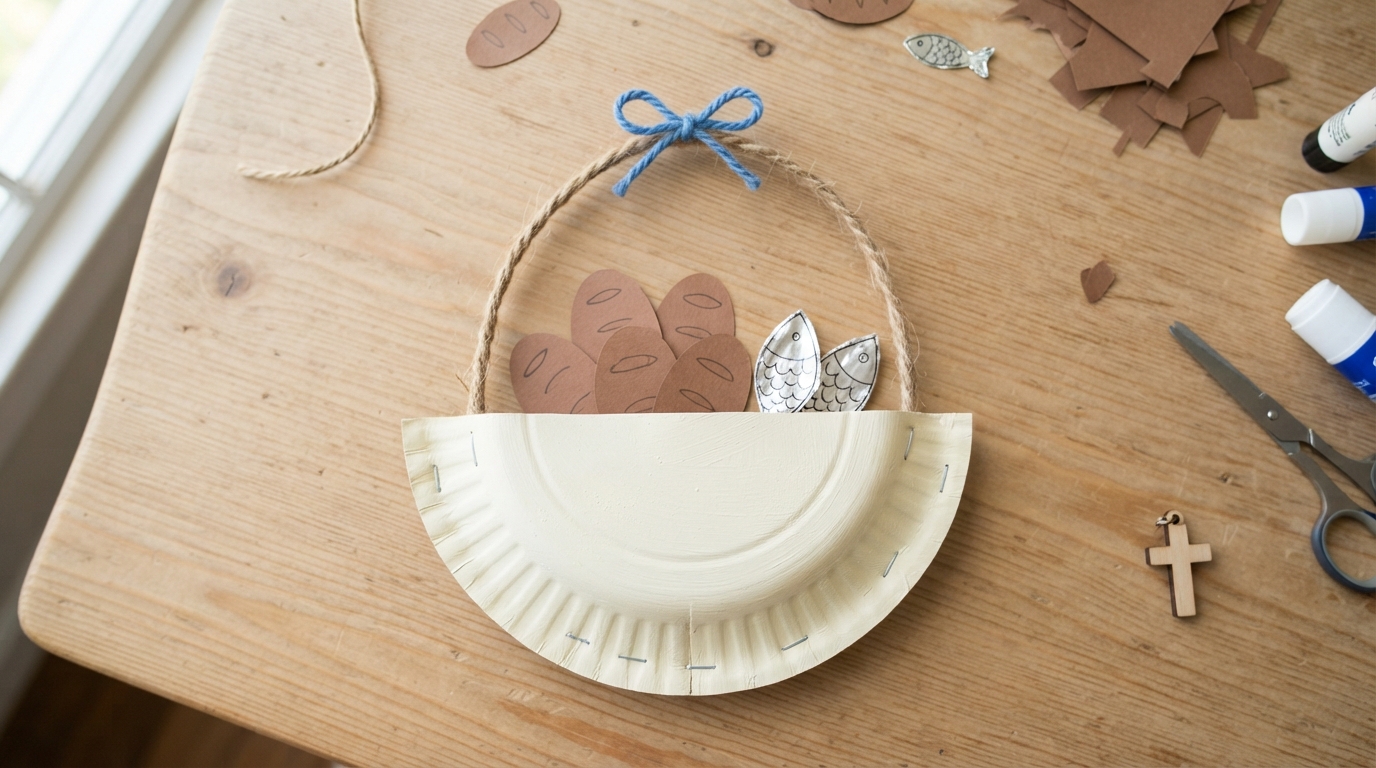
- Cut the paper plates in half. Each child will need two halves to make a “basket.”
- Pre-cut (or have the children cut) 5 small oval shapes out of brown paper (the loaves) and 2 small fish shapes out of silver or gray paper.
Instructions
- The Basket: Give each child two paper plate halves. Have them place the plates together so the bumpy bottoms are facing outward, creating a “pocket” inside.
- The teacher should staple the rounded edges of the plates together to seal the pocket, leaving the straight top edge open. Let the children color their basket!
- The Lunch: Give each child their 5 brown loaves and 2 silver fish.
- Have them write the numbers 1, 2, 3, 4, 5 on the loaves.
- The Miracle: Have them place their small lunch inside the paper plate basket.
Discussion While Crafting
- “How many loaves of bread did the boy have? How many fish?”
- “Was it enough to feed 5,000 people?” (No way!).
- “Did the boy hide his lunch, or did he share it with Jesus?” (He shared it!).
- “When you take this basket home, use it to tell your family the story of how Jesus multiplied a tiny lunch to feed thousands of people!”
Memory Verse
John 6:11 (BSB)
“Jesus then took the loaves, gave thanks, and distributed to those who were seated as much as they wanted.”
Practical Way to Teach:
- Teach this with hand motions.
- “Jesus then took the loaves,” (Hold hands out like cupping bread).
- “gave thanks,” (Fold hands in prayer and look up).
- “and distributed to those who were seated” (Make a passing motion to the left and right).
- “as much as they wanted.” (Rub your stomach like you are full).
Knowledge Check
Knowledge Check
Question 1 of 5Loading...
Application
You might look at yourself and think, “I’m just a kid. I can’t do anything important for God.” But Jesus doesn’t need you to be a grown-up or a billionaire. He just wants you to share what you have. This week, give Jesus your “loaves and fish.” Share your toys, write an encouraging note, or help a sibling. Watch how Jesus uses your small actions to do big things!
Take-Home Challenge
The next time you sit down to eat a meal with your family, ask if you can be the one to pray and give thanks. Thank God for providing your food, just like Jesus did on the mountain.
Closing Thought
When Philip looked at the crowd, he saw an impossible problem. When the boy looked at his lunch, he saw a tiny snack. But when Jesus looked at the lunch, He saw a miracle waiting to happen. God specializes in doing the impossible. When we give Him our small, imperfect lives, He multiplies them to show His glory to the world.
Closing Prayer
“Heavenly Father, thank You for sending Jesus, the true Bread of Life. Thank You that You always provide exactly what we need. Forgive us for the times when we panic and look at our problems instead of looking at Your power. Help us to be generous like the little boy, and to give You everything we have. Multiply our small gifts to show Your love to the world. In Jesus’ name, Amen.”
One-Minute Teacher Quick Reference
JESUS FEEDS THE FIVE THOUSAND
John 6:1-15
Big Idea
God can take what little we have and multiply it to do impossible things.
Memory Verse
“Jesus then took the loaves, gave thanks, and distributed to those who were seated as much as they wanted.” — John 6:11 (BSB)
Three Points
- Jesus Tests Our Faith
- God Uses What We Offer
- God Gives Abundantly
Opening
The Impossible Math Problem (Discussion about pizza slices and dividing small amounts of food).
Activity
A Lunch for Everyone (Visual object lesson showing a tiny lunchbox trying to feed the whole church).
Take-Home Truth
When I give Jesus the little bit that I have, He can use it to do big things.
Closing
Pray for a generous heart and the faith to trust God with impossible problems.